
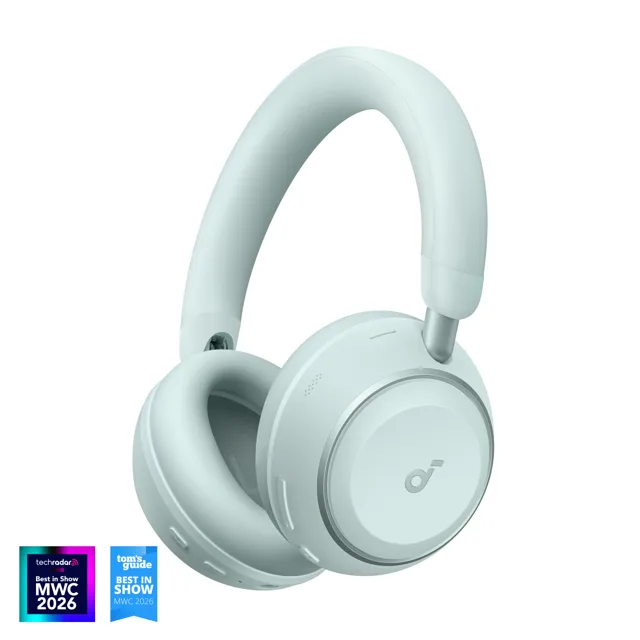
soundcore Space 2 Review
We may earn a commission from some links on this page.
The soundcore Space 2 is an over-ear pair aimed squarely at travel. soundcore lists a four-stage low-frequency noise cancelling system rated at -37 dB in the company's own lab, 40mm double-layer diaphragm drivers, LDAC over Bluetooth and Hi-Res audio when you plug in a cable. It weighs 264g, and soundcore quotes up to 50 hours with noise cancelling on or 70 hours with it off. This review works through those published figures and the practical limits that come with them.
Table of Contents
Key Takeaways
- A four-stage noise cancelling system is tuned for low-frequency sound, and soundcore puts its depth at -37 dB in the Anker lab.
- 40mm double-layer diaphragm drivers carry the sound, with Hi-Res audio over a cable and LDAC over Bluetooth.
- soundcore quotes 50 hours of playtime with noise cancelling on and 70 hours with it off.
- Five minutes of charging adds four hours of listening, according to the same lab figures.
- The pair weighs 264g, has multipoint for two devices and uses physical buttons rather than touch controls.
Noise Cancelling Built For Travel
Most of the noise in a plane cabin sits at the low end, and that is exactly where soundcore aims this pair. The four-stage system is built to block a wide band of low-frequency sound, from jet engines to the general rumble of a journey. soundcore describes the result as -37 dB of noise cancellation, a figure measured in the Anker lab rather than by an independent test house.
What that means in practice is that the low drone fades while higher sounds such as announcements and conversation remain partly audible, which is the usual behaviour of this kind of system. Adaptive ANC 3.0 adjusts the cancellation as the surroundings change, and Transparency mode lets you hear what is going on without taking the headphones off. The app also adds a Nap Mode that plays built-in white noise and keeps calls silenced, which is a practical touch for a long layover.
Drivers, Codecs and Wired Listening
Each side uses a 40mm double-layer diaphragm driver, and soundcore lists the frequency response as 20Hz to 40kHz. On the wireless side the pair supports LDAC, which carries roughly three times the data of the standard SBC codec and has to be switched on in the soundcore app. LDAC is an Android technology as far as this pair is concerned, so iPhone owners will not get it.
The wired mode is the more interesting one for anyone who cares about sound quality. Plug in a cable and the headphones accept Hi-Res audio, so a laptop or a portable player with a good output can feed them directly. There is an AUX input on the headphones, and the cable connection works alongside the controls rather than replacing them.
Battery and Charging
The headline figures are 50 hours with noise cancelling on and 70 hours with it off. soundcore notes that those numbers come from its lab, with wearing detection off and continuous playback at 50 percent volume, so real use with louder listening and a mixed signal will land somewhere below them. Even allowing for that gap, a pair that lasts several long-haul flights on one charge is unusual at this level.
Charging is quick when you are caught short. Five minutes on a charger gives four hours of playback, again measured at 50 percent volume with noise cancelling off. A full charge takes longer, and the practical benefit is the top-up rather than the full cycle: a short cable stop at an airport socket is enough to cover the next leg.
Comfort and Fit
The Space 2 weighs 264g and measures 156.38mm by 196mm by 86.22mm, which puts it in the same size class as most over-ear travel pairs. The headband is shaped to spread pressure, and the ear cushions use protein leather over slow-rebound memory foam, the combination soundcore credits with keeping the fit comfortable over a long flight.
Over-ear headphones at this weight rest on the head rather than clamp onto it, and a slow-rebound foam cushion is designed to keep the pressure even for hours. The trade-off of a sealed over-ear design is warmth around the ears during long sessions, which applies to every pair of this type rather than this one in particular.
Calls, App and Connections
Three microphones with AI enhancement handle calls, and the pair connects over Bluetooth 6.1 with multipoint, so a phone and a laptop can be held at the same time and switched between without repairing. Physical buttons control playback, volume and the noise cancelling modes, which is easier to use with cold hands than a touch panel.
The soundcore app is where the deeper settings sit: a custom EQ, a hearing protection limit, wearing detection and the Nap Mode white noise. soundcore also lists an AI assistant called Anka and real-time translation for more than 100 languages through the app, with the caveat that Android users need to keep the app running in the background for those features. None of it is required for normal listening.
Two alternatives are worth knowing about. The soundcore Q30 is the cheaper over-ear model with three noise cancelling modes, while the soundcore Space 2 Pro is the step up with adaptive noise cancelling and a stronger focus on call clarity.
Detailed Features
The table collects what soundcore publishes for the Space 2, so the noise cancelling, the drivers and the connection details sit in one place.
| Feature | What soundcore lists |
|---|---|
| Noise cancelling | Four-stage low-frequency system, Adaptive ANC 3.0, -37 dB (Anker lab) |
| Drivers | 40mm double-layer diaphragm, 20Hz to 40kHz |
| Codecs | LDAC over Bluetooth, Hi-Res audio over a cable |
| Battery | 50 hours with ANC on, 70 hours with ANC off, 5 minutes for 4 hours |
| Weight | 264g |
| Dimensions | 156.38mm by 196mm by 86.22mm |
| Connections | Bluetooth 6.1 with multipoint, AUX input |
| Calls | Three microphones with AI enhancement |
| App | Custom EQ, hearing protection, Nap Mode white noise, wearing detection |
Advantages and Disadvantages
The strengths are clear. The noise cancelling is aimed at the low-frequency noise that makes travel tiring, the battery figures are generous even after allowing for lab conditions, and the five-minute top-up charge covers a forgotten cable. The 264g build with slow-rebound memory foam is designed for long sessions, multipoint makes the pair practical for work as well as music, and the cable accepts Hi-Res audio for anyone who prefers a wired connection.
The weaknesses are just as clear. The -37 dB figure is the maker's own lab measurement, so treat it as a claim rather than a guarantee. LDAC only works on Android and has to be enabled in the app, so iPhone owners are limited to the standard codecs. The AI assistant and translation features depend on the app, and Android users have to keep it running in the background for them. The travel case is a separate purchase rather than part of the box.
Verdict
The Space 2 is the sensible pick for a frequent flyer who wants a quiet cabin, a battery that covers a long trip and a wired option for a laptop or player. The published noise cancelling depth comes from the maker's own lab, and the codec and app features favour Android owners, so an iPhone user should weigh those limits. For everyone else this is a well-equipped over-ear pair with the features that matter on a journey.
Frequently Asked Questions
How Deep Is the Noise Cancelling?
soundcore puts the depth at -37 dB, measured in the Anker lab with its four-stage low-frequency system. Independent measurements may differ.
Does It Work With a Cable?
Yes. There is an AUX input, and the wired mode supports Hi-Res audio. The controls sit on the headphones, so the cable does not remove them.
Which Devices Get LDAC?
LDAC works with Android devices and has to be enabled in the soundcore app. It is not available on iPhone.
How Long Does the Battery Last?
soundcore quotes 50 hours with noise cancelling on and 70 hours with it off, measured in its lab at 50 percent volume. Real use at higher volumes will be shorter.
Can It Connect to Two Devices?
Yes. Multipoint over Bluetooth 6.1 lets the pair hold two devices at once and switch between them.